
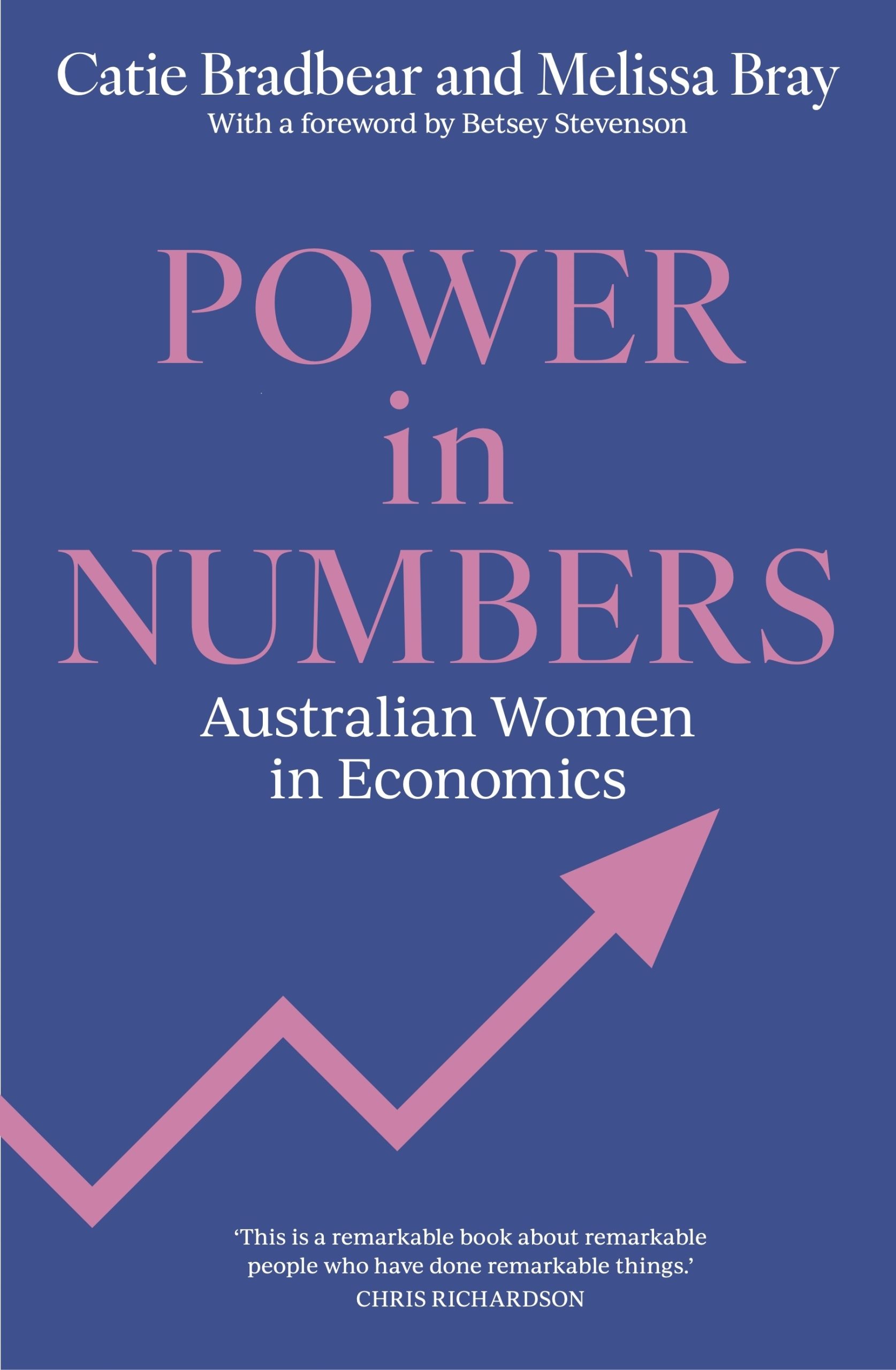
This is the full text of Power in Numbers (MUP), reviewed for Economic Record.
The central proposition of Catie Bradbear and Melissa Bray’s Power in Numbers is that representation matters. They begin with the “astonishing moment” that women, today, lead Australia’s most important economic institutions: Jenny Wilkinson as secretary to the Treasury, Michele Bullock as governor of The Reserve Bank of Australia, and Danielle Wood as chair of the Productivity Commission. Bradbear and Bray present profiles on sixteen trailblazing women economists, assembling interviews with nine contemporary economists alongside biographical accounts of seven historical figures from universities, government departments, central banking, international organisations and the private sector. The book is affiliated with the Women in Economics Network (WEN) and shares its commitment to increasing visibility and building a professional community amongst women economists. The profiles reveal some common themes: the role of inspiring teachers; mentors who offered advice and facilitated new opportunities; families who encouraged education and curiosity and their personal commitment to changing the world for the better. These are interesting and valuable profiles, and the authors are to be commended for bringing together such a prominent group of economists. The accounts are inspiring and make a career in the male-dominated economics profession seem a bit more accessible to young women.
Notwithstanding these strengths, this book is unsatisfying as a history of women in Australian economics. Bradbear and Bray acknowledged that they had to be ruthless in their selection of subjects but offered little rationale for their choices. Most of the women were the ‘first’ to do something, but several – Persia Campbell, Alison Booth, Meredith Edwards, Meghan Quinn and Jillian Broadbent – were tagged as simply ‘prominent’. This is not a comment on the women’s suitability for a history of women in Australian economics, which is unquestionable, but a rationale for the inclusion and exclusion of subjects was required here.
Bradbear and Bray are not really interested in the economics profession itself. The profiles are mostly presented as independent career narratives rather than an account of women’s place in the profession. The introduction does not contain a single mention or citation to other work that has charted the history of Australian economics, or women’s place in it. Historical context on economics education, university employment, the changing status of the discipline, public institutions or professional associations appear briefly, but quickly recede in favour of personal career narratives. The chapter on Persia Campbell, for example, states that Australian economics entered a ‘golden age’ in the 1920s, without explaining what this was or its significance for the topic at hand. Elsewhere, the book mentions women’s experiences of discriminatory employment practices, the marriage bar and contemporary concern about an increasingly homogenous population of economics students. These issues are introduced via the participants, but receive little attention from the authors. A ‘timeline’ is presented as an appendix, where general matters like the 1850s gold rush, the election of various prime ministers, and participation of women athletes in the 1900 Paris Olympics, are presented alongside issues covered in the profiles such as Persia Campbell earning her PhD or Jean Polglaze’s appointment as associate professor of economics. There is little contextualisation of this material, and so the broader history of women in economics remains unexplored.
The authors argue that they are not interested in documenting women’s negative experiences in the workplace. There is good reason to resist writing women’s history through the lens of discrimination, and women’s ambition, achievement and ability to overcome barriers deserves attention. At the same time, it risks presenting women’s ‘firsts’ as evidence that gender equality has been ‘fixed’. In the introduction, the authors declare that “the glass ceiling has been broken” and that trailblazers “became a symbol of what Australian women could achieve” (p.1). Being a woman in economics was presented positively for the most part, with Luci Ellis, for example, commenting that “most of the chief economists that you see around now are women […] I think there has been a really big pivot there” (p.88). Some women discussed unequal treatment as a problem of the past that has now been resolved. For example, Michele Bullock mentioned Mary Debenham who, in the post-WWII decades, was forced to resign from the RBA when she married. This was immediately followed by the authors’ interjection that “Fortunately for Michele, times had changed” (p.41). Although improvement in women’s status over time is undeniable, it is incorrect to imply that inequality has disappeared. Indeed, if it had, women’s ‘firsts’ would not be so unusual as to warrant this book.
The book’s focus on individual success limits its capacity to explain or demand change. Bradbear and Bray repeatedly ask their subjects to identify the “superpower” that enabled their success. The women nominate sensible qualities such as hard work, energy, resilience, humour and integrity. They encourage junior economists to seek mentors, speak in meetings, take opportunities and learn to manage imposter syndrome. At the same time, the superpower metaphor ignores the way that collective activism has improved women’s workplace outcomes. Women’s place in economics today has as much to do with the removal of the marriage bar, for example, as to women’s individual tenacity. A focus on ‘superpowers’ also relocates responsibility from unequal institutions to the women working within them. A pattern of speech may inhibit a career, but it is also necessary to ask who are typically listened to at work. Finally, the emphasis on individual achievements obscures differences between women. Trailblazers, of course, are marginalised on the basis of their gender, but they also possess the education, resources and professional support needed to cross barriers that are unsurmountable for others. To highlight “superpowers” is to assume all women are equally able to advance, and that those that do not lack certain innate characteristics. Taken together, the discussion of ‘superpowers’ neglects the historical and contemporary realities that continue to make women ‘firsts’ unusual, and the way that privilege accrues on lines of race, class, sexuality and so on. More concerningly, the focus on optimising individual women leaves little room to demand structural change that will benefit everyone.
Power in Numbers offers an engaging record of women’s achievements in Australian economics. The profiles are accessible and animating and will likely inspire future women in the profession. It shows why representation matters, but it also highlights that ‘numbers’ alone are insufficient measures of equality. The exceptional women profiled in this book have crossed the barriers in Australian economics, but it is up to future researchers to account for why those barriers exist, how they perpetuate inequality today, and how to dismantle them to ensure equality for all.
0 Comments