
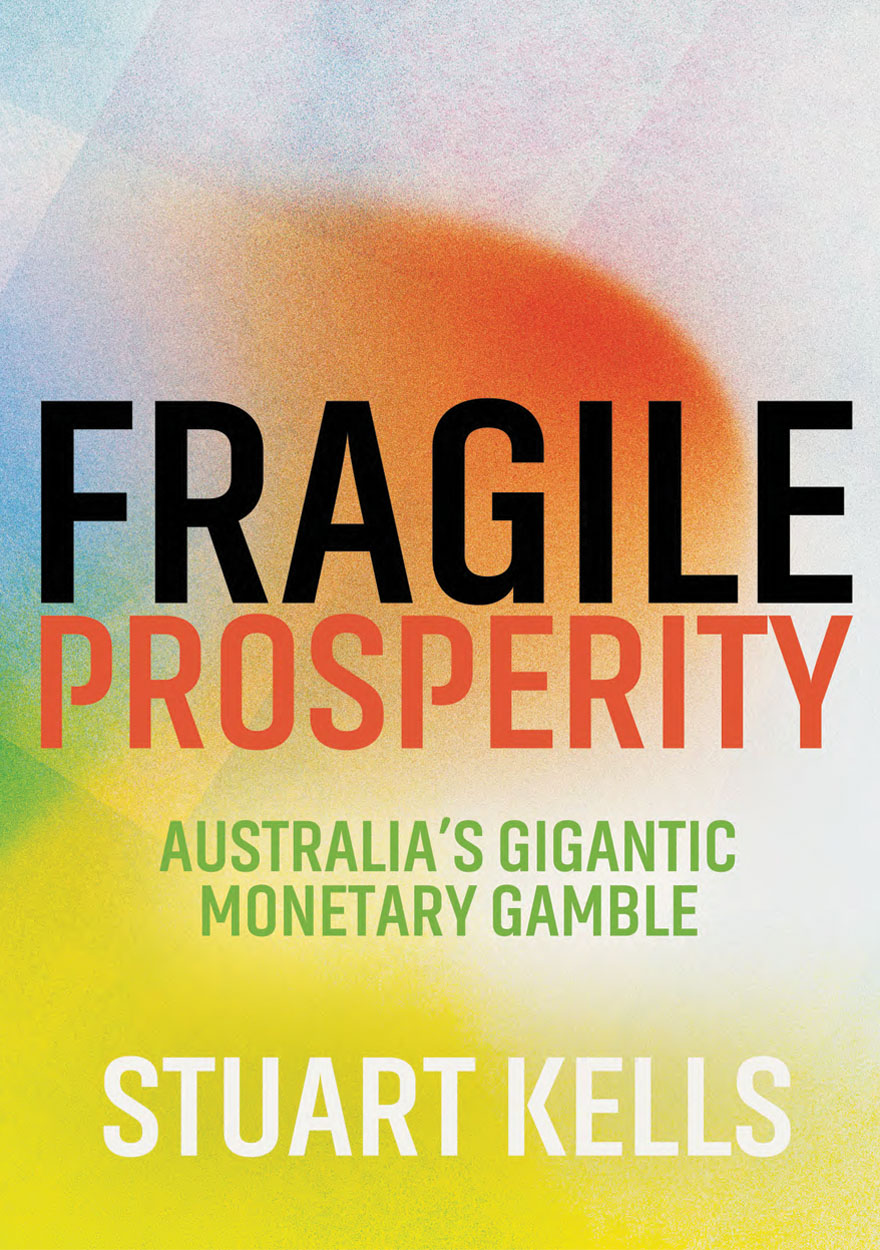
This the full text of my review of Kells’ Fragile Prosperity (ANU Press), which was published recently in Australian Historical Studies.
Stuart Kells, in Fragile Prosperity, argues that Australia’s wealth rests on expensive land, highly indebted households, and oligopolistic banks. Originating in speeches, and published for ANU Press’ ‘Public Matters’ series, Kells’ book attributes Australia’s current challenges to financial deregulation initiatives of the 1980s. He argues that this transformed the nature of money in the Australian economy, with bank lending becoming the main source of new money, and inflation, over the past 30 years. Australia’s ‘fragile prosperity’, he argues, depends on the protection of property values and households’ willingness to assume debt, at the expense of other objectives.
The book is valuable for its interpretation of the housing debate, which resists scapegoating of investors, migrants, ‘baby boomers’ or millennials. It refocusses attention on the institutions that have intensified the class interests of owners (who prefer price growth), banks (who want mortgage values to increase), buyers (who initially want lower prices, but quickly revert to the class politics of owners), and governments (who benefit from property transactions, and are answerable to voters). The book also brings helpful attention to the inequalities associated with house price growth, with benefits accruing to those who already have a house, and away from those who do not. This is a very important subject, and it certainly deserves more meaningful attention.
Kells begins with nine propositions that constitute an ‘orthodox’ picture of money and banking. In a highly selective intellectual genealogy, Kells enlists thinkers ranging from John Law and John Maynard Keynes to Simon Kuznets, contemporary central-bank economists, and undergraduate textbooks. There is little rationale for the inclusion of each (above others) or narrative of how ideas about money have changed over time. Despite the book’s later focus on Australia’s specific legal and institutional arrangements, the opening treats money as timeless and universal. This will be unsatisfying to historians interested in a contextual reconstruction about the way money works.
Kells then presents his ‘alternative and correct orthodoxy’ (61), which argues that banks do not simply repurpose existing savings, they create ‘new’ money from loans and then find the reserves to support that level of lending. This is the least controversial part of the book, mostly because it is well-established in the endogenous monetary and post-Keynesian economics literatures. Kells acknowledges some precedents but mostly ignores these traditions. So, although his propositions are a reasonable synthesis, they imply a level of novelty that the book does not really earn.
Next, Kells argues that this new money increases property prices. He argues that new lending creates purchasing power that enables buyers to enter the housing market. This increases prices, which increases the amount of collateral or ‘equity’. More collateral then facilitates larger loans, which further increases prices. This is consistent with the Australian experience of household debt and residential property values over the past three decades.
Third is Kells’ historical work, in which he argues that financial deregulation in the 1980s transformed the way money works. He argues that this moved mortgage provision from ‘non-money-creating’ institutions (like building societies) to money-creating banks. Residential property increasingly became a way to create new money, and this led to the self-reinforcing cycle between credit, equity, and property prices. This is a significant historical thesis but is insufficiently established. Kells draws on a limited corpus of historical material to establish that: a) banking deregulation occurred and b) ‘non-money-creating’ institutions were important before deregulation. His draws on the report of the 1981 Campbell Committee of Inquiry into the Australian Financial System; publications, commentary and statistical series from the Reserve Bank; Robin Gollan’s history of the Commonwealth Bank; and David Merrett’s research on housing finance. Aside from this, the book does not engage substantively with the economic history literature on Australian banking for the bigger question of how money changed.
This presents a genuine opportunity for historical work that examines the important issue of deregulation, bank-created money and Australian property prices. Analysing the lending practices of banks, building societies, life insurers and other providers, before and after deregulation, would make a real contribution. Estimating how much additional money was created due to deregulation is essential quantitative work. There is also an opportunity for a microeconomic or social history, analysing the way regulatory changes altered lending and purchasing decisions.
Finally, Kells argues that new bank lending is responsible for all inflation. Relying on the quantity equation, he reasons that because monetary velocity has fallen since the 1990s, all inflation resulted from growth in the money supply. Attributing money supply growth to bank lending, he concludes that bank lending has been responsible for nearly all inflation. Troublingly, although the quantity equation describes a relationship between money, prices, output and velocity, it does not identify the direction of causation. Money supply may facilitate inflation, but equally a supply disruption – the closure of the Strait of Hormuz or NIMBYs blocking higher housing density – can increase prices before lending rises to meet those higher nominal financing needs.
Fragile Prosperity is accessible, energetic and makes a valuable contribution in its insistence on the importance of Australian institutional history for understanding the economy. In proposing that deregulation in the 1980s altered the way money worked, Kells also identifies a terrific historical question, but in this format his book leaves that question largely unanswered.
0 Comments